> Development > Disaster Management


"Everything that is human-made is destroyed."
That sentence, spoken from one of the districts north of Kathmandu after the Bhotekoshi came down on the morning of 26 August, is the most precise summary of the disaster I have read. It is also, if we are honest, a description of a choice.
More than 900 people are confirmed dead and close to 4,250 remain missing. Forty-one bridges and forty-two kilometres of road are gone, along with twenty schools and two rural municipality offices. Twelve hydropower projects were hit; six plants were directly damaged, removing roughly 431 megawatts - about eight per cent of Nepal's generating capacity - from the grid in a single morning. More than a hundred workers are missing from the Upper Trishuli-1 site alone. The trigger, current assessments suggest, was a collapsing glacier high in the mountains between Nepal and Tibet.
The road from Syafrubesi to Rasuwagadhi that was washed away was still under reconstruction. It was being rebuilt after being destroyed by flooding in July 2025.
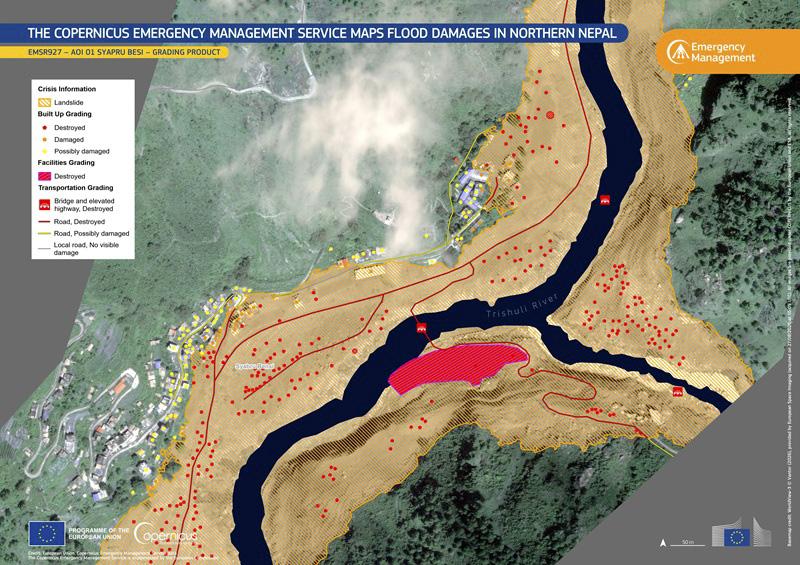
(Satellite Image Credit: WorldView-3 © Vantor (2026), provided by European Space Imaging (acquired on 27/08/2026 at 05:05 UTC).
All images are provided under COPERNICUS by the European Union and ESA, all rights reserved)
We should be clear about who was standing in the water. People do not settle on active floodplains, unstable slopes and glacier-fed valleys because they misjudge risk. They settle there because that is the land available to them. Safer ground is owned, expensive, or simply somewhere else. Living in a fragile place is very often what poverty looks like in mountain terrain.
These households already carry a permanent, low-grade fear - about the monsoon, about the slope above the house, about whether the road will hold. Then a mega-structure arrives in the valley: a dam, a tunnel, a diversion, a construction camp. They are told it is development. What many of them experience is one more variable they cannot control, in a landscape they already know to be unreliable.
The Himalaya is not a stable backdrop. It is the youngest major mountain system on earth, still rising along the collision boundary of the Indian and Eurasian plates, and it releases that strain regularly. The 2015 Gorkha earthquake killed nearly 9,000 people and damaged more than a dozen hydropower facilities. In January 2025, a magnitude 7.1 earthquake struck the Tibetan Plateau. Slopes loosened by shaking do not fail immediately; they fail years later, in the rain.
Onto this we are now adding a second, faster instability. The Hindu Kush Himalaya Assessment concluded that even if global warming were held to 1.5°C, the region would warm by around 2°C, and a third of its glacier ice would be lost by 2100. The IPCC has stated with high confidence that glacier retreat and permafrost thaw are decreasing the stability of mountain slopes and increasing the number and area of glacial lakes. ICIMOD has reported that Himalayan glaciers lost mass around sixty-five per cent faster in the 2010s than in the decade before.
Do we not know this? We know it very well. It is in the assessments, in the peer-reviewed literature, and in the observed record of the last five monsoons.
Our own work on the Brahmaputra basin (https://link.springer.com/article/10.1007/s41101-024-00305-4#citeas), using downscaled NASA NEX-GDDP projections, found monsoon precipitation increasing by 7.7 to 10.7 per cent by 2050 and by 18.1 to 38 per cent by 2099, depending on the emissions pathway. Maximum one-day rainfall rises by 2.2 to 4.5 mm per decade, maximum five-day rainfall by 2.33 to 4.9 mm per decade, with consecutive wet days increasing particularly in the upper basin - precisely where the dams are going.
This is the context in which China has begun building the Medog hydropower station on the Yarlung Tsangpo, a 60-gigawatt project on the Great Bend, in one of the most seismically active gorges on the planet, upstream of 130 million people in India and Bangladesh.
I have argued before that India, as a downstream riparian, has every right to ask hard questions about such a project. This month has strengthened that argument, but it has also complicated it. India is itself planning a large dam on the Siang, partly as a buffer against Medog. We cannot demand caution upstream and abandon it at home.
What worries me most about events such as this is not only the complexity of the hazard, but how easily we continue to treat such risks as normal in some of the most fragile landscapes we have. People here experience these risks not as abstract probabilities but as everyday uncertainties - about their homes, their livelihoods, their mobility, their safety.
This is why we need to listen far more carefully to those who study communities and the dangers they live with. When researchers ask whether a project is increasing exposure or creating new forms of risk, that work should not be dismissed as the dismal science.
In fragile landscapes, research that makes people's fears and vulnerabilities visible is not pessimism. It is a warning, and warnings exist to inform better decisions.
Taking those fears seriously is not anti-development. It is what responsible development requires.
 Navigations
  Quick Contact
 Subscribe Us
 Quick Mail